2026-08-21
DAF thermo-compression versus epoxy die attach: what should decide it
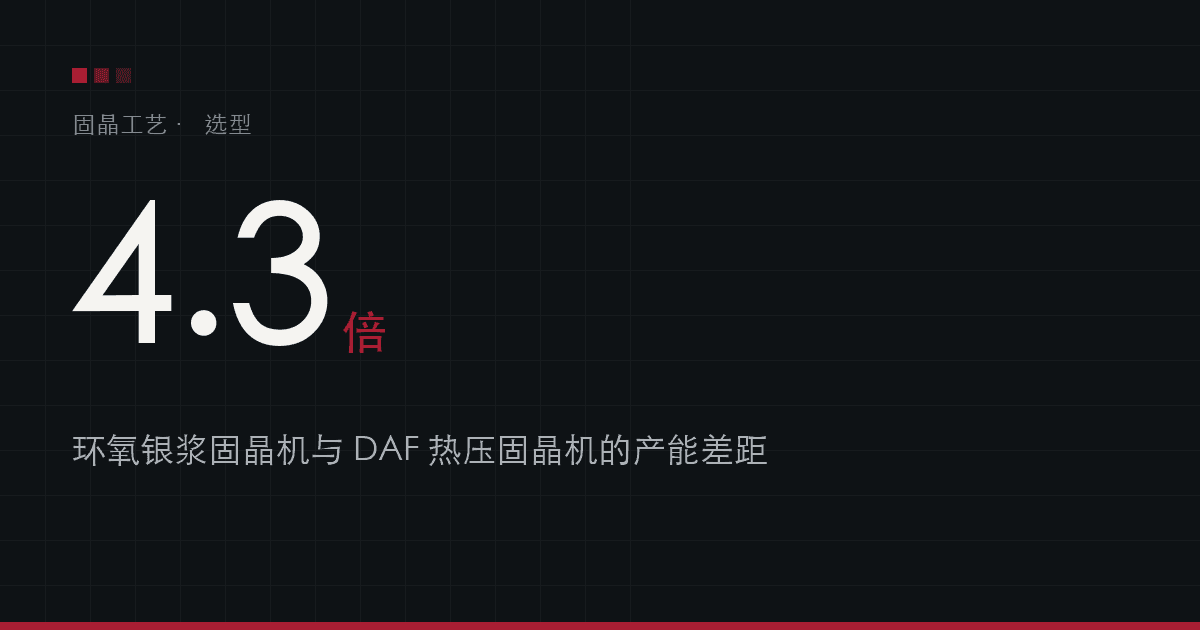
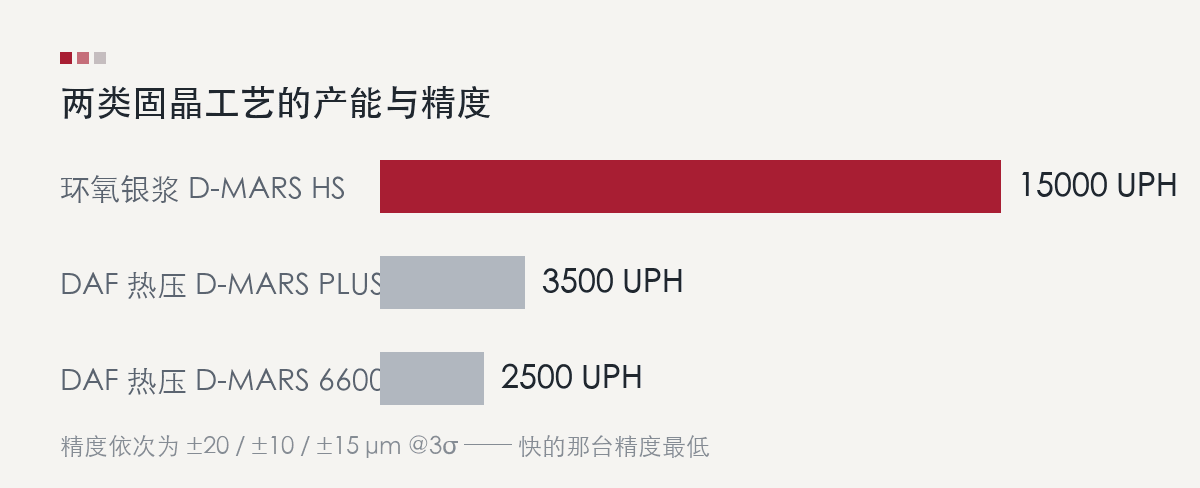
Reading a die attach datasheet, throughput is usually the first number that registers. An epoxy (silver paste) die bonder reaches 15,000 UPH. A DAF thermo-compression bonder reaches 3,500 — a factor of 4.3.
That gap invites the wrong conclusion. The two machines do not solve the same problem.
Where the gap comes from
Epoxy die attach dispenses adhesive, picks the die, places it, and cures later in a separate oven. The placement itself does not require dwell at the station.
DAF thermo-compression is different. The die carries a pre-applied DAF film, and placement applies controlled heat and force so the film bonds to the substrate or to the die below. That heat-and-pressure step has a defined dwell time which cannot be compressed by moving faster. Most of the difference between a 500ms and a 250ms cycle comes from here.
The throughput gap is set by the process, not by one class of machine being built less well.
What should decide it
The first question is not throughput but attach material:
- Epoxy silver paste — the mainstream in conventional packaging. Conductive, thermally capable, low cost, fast cycle. Suited to single-layer attach where bond line thickness uniformity is not critical
- DAF film — bond line thickness is set by the film itself, giving far better consistency than dispensing. In multi-die stacks the thickness error accumulates layer by layer and drives total stack height, which makes DAF close to mandatory
The second question is die thickness. Ultra-thin die around 0.05mm can lift under uneven dispensed adhesive; DAF loads them more evenly.
The third is stack count. Memory devices with many stacked layers accumulate bond line variation that dispensing struggles to hold.
When throughput does decide
Throughput enters the decision only once material and process are settled and both machine classes qualify. That situation is real — mid-volume products with relaxed bond line requirements can go either way.
What then matters alongside UPH:
- Placement accuracy — epoxy bonders typically sit around ±20μm @3σ, DAF thermo-compression around ±10 to ±15μm @3σ. If downstream needs the tighter figure, the faster machine simply does not qualify
- Downstream cost — epoxy needs a cure oven and the floor space for it; DAF removes that step but the film costs more
- Changeover time — on high-mix lines, changeover downtime can affect real output more than cycle time does
A common misreading
Accuracy figures need their statistical basis. ±20μm and ±20μm @3σ are different statements; the second means 99.73% of placements fall within the window. Confirm both vendors quote on the same basis before comparing numbers.
Our platforms in both processes
- D-MARS HS — high-speed epoxy die bonder, 15,000 UPH, 250ms cycle, ±20μm @3σ, up to 12" wafer
- D-MARS PLUS — second-generation DAF thermo-compression bonder, 3,500 UPH, ±10μm @3σ, 0.9×0.9–25×25mm die, 50–7000g programmable bond force
- D-MARS 6600 — first-generation DAF TC bonder, 2,500 UPH, ±15μm @3σ
Which class applies to a given product depends on your attach material, die specification and downstream requirements. Send us those and our applications team can suggest a platform and work through the cycle time.